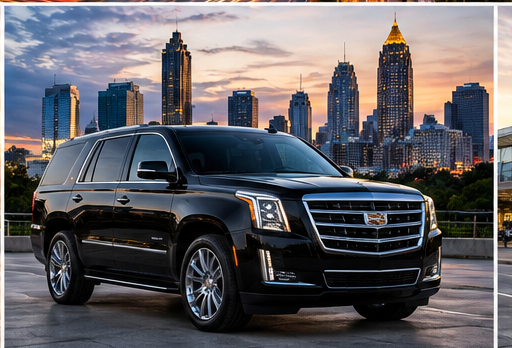

Illustrative photograph. You book a vehicle class, not a specific make or model.
For most companies, the best corporate car service is neither a purely local operator nor a national brand on its own, but a combination: local chauffeurs who know the airports, roads and venues, booked through one national desk that sets one standard, one price policy and one invoice. Local knowledge decides whether a ride goes smoothly; national reach decides whether your travel program is manageable. You want both.
What local operators do best
A chauffeur who drives the same city every day knows things no booking system can: which terminal door the airline actually uses, where the curb is enforced and where it is not, how long the drive really takes at 4:45 on a Thursday, which hotel entrance is best for a discreet pickup, and how to get around a stadium on game night. That knowledge is what turns a booking into an on-time pickup.
Local operators are also close to the problem. When a flight diverts or a meeting runs over, a dispatcher in the same market can move a car quickly because they know where their vehicles and chauffeurs are.
Where purely local breaks down for a company
The trouble starts when a company travels to more than one city. Each local provider has its own booking process, its own price structure, its own cancellation policy and its own invoice. A travel coordinator ends up managing a list of vendors, reconciling different formats every month, and re-checking insurance and standards for each one. Quality varies by city, and there is no single place to escalate when something goes wrong.
Where purely national breaks down
National brands solve the vendor-list problem, but most do not own vehicles in every city they serve. The industry norm is that a national reservation is fulfilled by an independent local operator. That model works well when the national company is genuinely accountable: it vets the operator, sets the standard, and stands behind the ride. It works badly when the national layer is only a call center that passes the booking along and has little say over who shows up.
The model that combines both
The strongest setup is honest about how rides actually happen and puts accountability in one place:
- Vetted local operators drive the rides, bringing the local knowledge that makes pickups work.
- One national desk books, prices, dispatches and invoices, so every city runs on the same policies.
- One written standard covers vehicles, chauffeur conduct, flight tracking, wait time and communication, and the desk enforces it.
- One invoice covers every city, with each ride itemized.
This is how Executive Black Car works. We book, price, dispatch and invoice every ride across 27 US cities, and the rides are driven by vetted independent local chauffeur operators. We do not claim a fleet or an office in every city; we claim responsibility for the booking, the price and the standard, which is published on our standards page. You can see every market in our city directory.
How to evaluate any corporate car service
Whichever model you choose, the same checks apply. Ask for answers in writing.
| What to check | What to ask for | Why it matters |
|---|---|---|
| Insurance | A certificate of insurance (COI) for commercial auto liability, naming your company as certificate holder if your policy requires it | Personal auto policies generally do not cover paid passenger transport |
| Licensing and permits | State and local operating authority and airport permits for each market | Unpermitted operators can be turned away at airport curbs |
| Chauffeur vetting | How drivers are screened (background checks, driving records) and who does it | Duty of care for your travelers |
| Dispatch hours | Whether a live person answers 24/7, including overnight and holidays | Problems happen at 5 a.m. and after midnight |
| Pricing | All-inclusive quotes with gratuity and fees included, and a clear surge policy | Budget accuracy and no invoice surprises |
| Invoicing | Consolidated monthly billing, itemized by ride, traveler and cost center | Reconciliation time for finance and assistants |
| Policies | Flight tracking, free wait time, cancellation window | What happens when plans change |
Insurance and licensing
Minimums vary by jurisdiction. For interstate passenger carriers with vehicles seating 15 or fewer, the federal minimum liability coverage is $1.5 million (FMCSA, 49 CFR 387.33); state and city rules differ for trips within a state, and many corporate travel policies set their own higher requirement. Local licensing also varies: some jurisdictions, such as New York City (Taxi and Limousine Commission) and California (California Public Utilities Commission), require specific for-hire permits. A national provider should be able to show that every operator it uses meets the local rules.
Dispatch and escalation
Ask who you call when a chauffeur is late and what they can actually do about it. A 24/7 line staffed by people who can reassign a car is worth more than a polished app.
Pricing and invoicing
Compare quotes on an all-in basis. A base-rate quote that adds a 20% gratuity and airport fees later is not comparable with an all-inclusive one. For recurring travel, a corporate account should consolidate every city onto one invoice without requiring a minimum spend or long contract.
Which approach fits your company
If all of your travel happens in one metro area and you already have a trusted local operator, staying local can be the simplest answer. Once your travelers move between several cities, or your finance team wants one vendor, one standard and one invoice, a national desk that works with vetted local operators usually gives you both the local knowledge and the control. To see what a trip would cost, get an instant all-inclusive quote.
Quick answers
Is a national car service better than a local one for corporate travel?
Not automatically. Local operators bring knowledge of airports, roads and venues; a national desk brings one standard, one price policy and one invoice across cities. For companies that travel to more than one city, a national desk that works with vetted local operators usually combines both.
Do national car services own their vehicles in every city?
Most do not. National reservations are commonly fulfilled by independent local operators. What matters is whether the national company vets those operators, enforces a written standard and takes responsibility for the ride and the invoice.
What documents should I ask a corporate car service for?
Ask for a certificate of insurance for commercial auto liability, proof of state or local operating authority and airport permits, a description of chauffeur screening, written policies on wait time and cancellation, and a sample invoice.
Can one corporate account cover rides in multiple cities?
Yes, with a national provider. Executive Black Car corporate accounts cover rides in all 27 of our US cities on one monthly invoice, with no minimum spend and no contract.